
Salmon Arm Residents Urge Province to Act as Highway 1 Encampment Grows on Crown Land
Lucas Tremblay
7/10/20264 min read
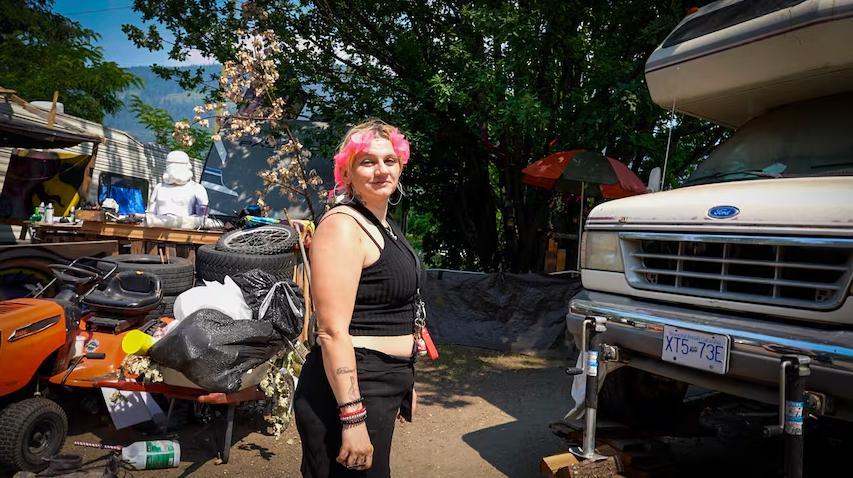
A growing roadside encampment on the outskirts of Salmon Arm, B.C., has become a flashpoint for nearby residents, unhoused people living at the site, and local officials who say the city has little power to intervene because the land is under provincial jurisdiction.
The encampment, located just off Highway 1 near Lakeland Mobile Home Park, began several years ago with a single recreational vehicle. Residents say it remained relatively quiet for a long time. But in recent months, it has expanded to include roughly 10 RVs, travel trailers and tents at a roadside pullout that has no outhouse, no formal waste removal and no regular municipal services.
For people living nearby, the growth has raised concerns about sanitation, fire safety and the lack of clear responsibility from government.
“Our concern is, it is growing and it’s growing rapidly,” said longtime Lakeland resident Linda Achtymichuk. “The major concern is health and safety.”
Achtymichuk, who has lived in the mobile home park for more than a decade, said residents are not approaching the issue without compassion. She said many people in the community recognize that those living at the encampment are facing difficult circumstances.
But she said the absence of basic services has created risks for both the people living there and the surrounding neighbourhood.
“It’s not a lack of compassion,” she said. “It’s a concern for us, but also for them.”
A Jurisdictional Gap
The central challenge is that the encampment is not located on municipal land. It sits on provincial Crown land managed by B.C.’s Ministry of Transportation and Transit.
That means Salmon Arm’s bylaws cannot be enforced at the site, and city services cannot operate there in the same way they might within municipal boundaries.
Residents say they have sent dozens of emails to local, provincial and federal officials asking for action, but they remain frustrated by the lack of a clear response.
In a statement, the Ministry of Transportation and Transit said it is working with the Ministry of Housing and Municipal Affairs and Interior Health to monitor the encampment. The ministry also said there are no immediate highway maintenance concerns.
For residents living next door, that response does not go far enough.
Concerns Over Sanitation and Smoke
Lakeland resident Steve Murphy, who has lived in the mobile home park for just over five years, said unpleasant odours from the area have become increasingly difficult to tolerate, especially late at night.
“We’ve had to shut all the windows,” he said. “You can’t take it. You can’t breathe.”
People living at the encampment dispute the source of the smell.
Mel Gray, who lives at the site, said she and others there notice the odour as well, but believes much of it comes from manure being spread on nearby fields. She acknowledged, however, that the encampment itself is messy and that there can be a sewage smell when people empty septic tanks.
Gray said residents of the encampment have been told they can remain if they clean up the site, and she says they have been trying to do so.
“We’re slowly getting it cleaned up because we have been talked to about it,” she said. “We were told we’re allowed to stay here if we clean it up.”
According to Gray, outreach workers, local residents and friends visit the encampment several times a week to deliver food and water and help remove garbage.
‘Nowhere Else to Go’
For those living at the encampment, the site is not a lifestyle choice but a last resort.
Gray said many residents cannot afford campsite fees, let alone market rent. She said people living on social assistance are finding it nearly impossible to secure housing as costs continue to rise.
If evicted, she said, she and her partner would simply have to find another place to camp.
She also said some residents are dealing with substance use disorder, mental illness, trauma, disability and other barriers that make stable housing difficult to obtain and keep.
For some, shelters have not provided a workable solution.
The encampment, Gray said, has become a place where people who have nowhere else to go at least have some support from one another.
Trauma Behind the Tents
Among those living at the site is Joseph Penner, who lost his home and his cat in the 2023 Bush Creek East wildfire.
The loss, he said, changed the course of his life.
“I kind of couldn’t handle losing my house,” Penner said. “It kind of wrecked me and shook me up a bit.”
Penner said he did not have insurance and has struggled to maintain employment since the fire. While life at the encampment is difficult, he said it has also provided a sense of community.
People there check in on one another, share what they can and offer support in a situation where formal systems have not been enough.
For Penner, that sense of mutual care has mattered.
City Says Province Must Act
Salmon Arm Mayor Alan Harrison said the city will continue pressing the province to take responsibility for managing the site.
In his view, that could mean providing basic services such as water, sanitation and outhouses to make the encampment safer and cleaner. It could also mean finding people living there a more appropriate place to stay.
But because the land is provincially managed, Harrison said the city cannot solve the issue on its own.
The situation reflects a broader problem facing many B.C. communities, where homelessness, housing affordability, public health, addiction, mental health and jurisdictional responsibility overlap in ways that leave both housed and unhoused residents frustrated.
A Community Waiting for a Plan
For Lakeland residents, the immediate concern is safety and livability. They want the province to step in before the encampment grows further or a more serious incident occurs.
For encampment residents, the fear is displacement without any real alternative.
And for the City of Salmon Arm, the issue has become a test of whether the province will provide direction and support on land the municipality does not control.
For now, the encampment remains in place at the edge of Highway 1 — visible, growing and unresolved.
Both sides say the current situation cannot continue indefinitely. But without housing, services or a clear provincial plan, the roadside camp has become another example of how B.C.’s housing crisis often lands hardest in the places least equipped to manage it.
News
Stay updated with the latest BC news stories, subscribe to our newsletter today.
SUBSCRIBE
© 2026 Innovatory Labs Inc. All rights reserved.
LINKS