
Rare ‘ghost magpies’ with pale plumage spotted in Fort St. John
Emma MacLeod
12/31/20252 min read
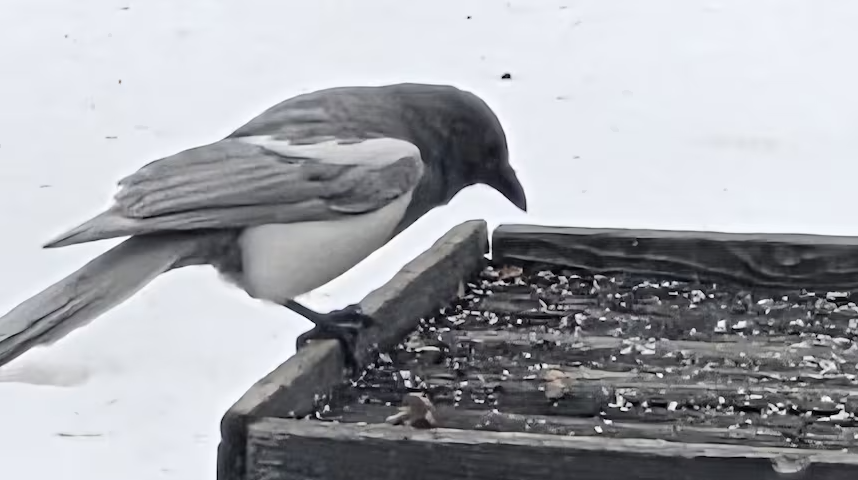
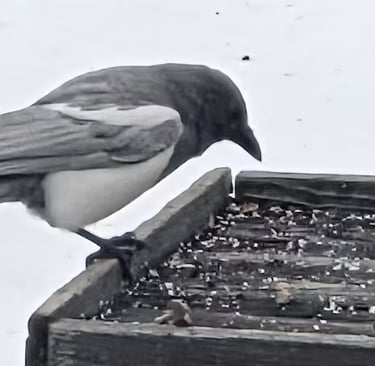
A Fort St. John, B.C., backyard has become the unexpected home of two strikingly unusual birds — pale, grey-and-white magpies often referred to as “ghost magpies.”
Resident Niki Hedges captured photos of the birds over the holidays after noticing their unusual colouring. The magpies are leucistic, a condition that reduces pigmentation and gives animals a washed-out or white appearance. While similar to albinism, leucism does not typically affect eye colour.
Hedges says she first noticed the birds about three years ago but wasn’t able to photograph them until recently.
“I just have an affinity with birds,” she said. “I’ve always paid attention to them.”
Having grown up in England, Hedges says magpies have long carried symbolic meaning for her. A well-known nursery rhyme frames magpies as omens — sometimes lucky, sometimes not — but always noteworthy.
“‘One for sorrow, two for joy,’” she recalled. “So I’ve always liked magpies.”
Even without their usual dark colouring, Hedges finds the birds captivating.
“Regular magpies have these beautiful iridescent blues and greens when the sun hits them,” she said. “But these ones are beautiful in a different way.”
The ghost magpies she photographed are light grey and white, blending in with winter surroundings. Hedges suspects they may not be alone.
“They seem to be hanging around,” she said. “It feels like there might be a small population growing and mixing in with the regular magpies.”
Dr. Ken Otter, who runs The Bird Cave — an avian behaviour and research lab at University of Northern British Columbia — says leucism in birds isn’t fully understood.
“There’s still a lot we don’t know about why it happens,” Otter said, noting it may have similarities to other rare colour mutations found in wildlife.
He pointed to the Kermode bear — also known as the spirit bear — which appears white due to a genetic mutation that prevents the production of melanin, despite not being albino.
Otter added that leucism in birds may also be influenced by environmental stress.
“Melanin is added to feathers while they’re growing,” he explained. “If a bird is under stress during that period, it can interfere with normal pigment development, resulting in white or pale feathers replacing ones that would normally be dark.”
Whether genetic, environmental, or a mix of both, sightings like these are uncommon — and for Hedges, meaningful.
“They’re just special to see,” she said. “It makes you stop and really look.”
News
Stay updated with the latest BC news stories, subscribe to our newsletter today.
SUBSCRIBE
© 2026 Innovatory Labs Inc. All rights reserved.
LINKS