
Nisga’a Village of Gingolx Raises Two Welcome Poles in Celebration of Culture and Resilience
Lucas Tremblay
2/18/20262 min read
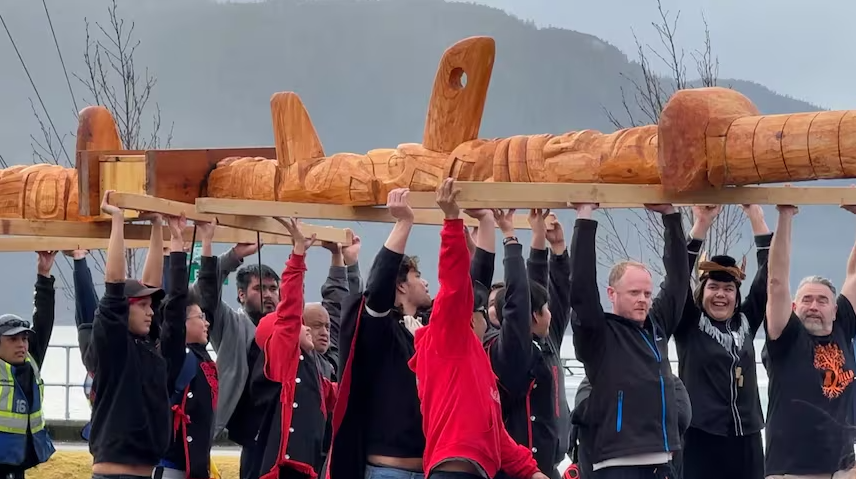
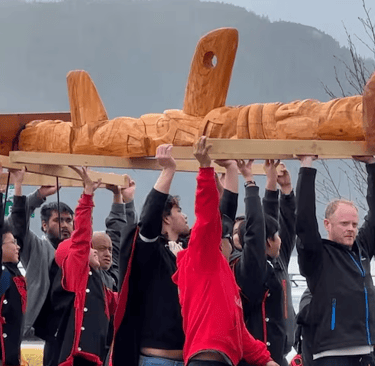
Two newly carved welcome poles now stand inside the Gingolx Memorial Recreation Centre, symbolizing strength, history, and cultural resurgence in the Nisga’a village of Gingolx.
The small community of about 400 people sits at the confluence of the Ksi Gingolx and Nass rivers in northeast B.C., and this month marked the first large-scale pole raising in at least 15 years, according to residents.
A team of six carvers worked on the poles since October, dedicating months of craftsmanship to the project.
The first pole, named Ganoonaxgum, honours the strength of women in Nisga’a society. The second, Git Saxwhl Aks, meaning “people of the river mouth,” commemorates the community’s deep connection to its land and history.
Hundreds gathered for the ceremony, filling the recreation centre with prayer, drumming, dancing, and celebration. The event also included a community feast, bringing together families, elders, and visitors from across the region.
“If a pole fell, that would tell us it was never meant to be raised,” said deputy chief councillor Darnell Stewart Sr., whose Nisga’a name is Sim’oogit Gawaakhl. “But both poles went up without a hitch. That’s what got everyone so excited. That’s life. That’s our life. Our identity, back with us again.”
Each tribe currently living in Gingolx is represented on the poles, Stewart added, reinforcing the shared identity of the village.
Inspiring a new generation
For the carvers, the project carried deep personal meaning.
Sam Peel, whose Nisga’a name Daxgadim Milligum Gaanaw translates to “strong frog dancer,” described the raising as a moment of pride and resurgence.
“What’s really special is that people who haven’t had the chance to carve were coming by every day to watch,” Peel said. “They get inspired. A lot of youth are really interested in this part of our culture.”
Peel and the carving team worked late into the night before the ceremony, completing final details to ensure the poles were ready for the celebration.
Carver Darren Stewart, whose Nisga’a name Wil’Gihee’em Gam Gibuu means “man who likes to work on wood,” said the project was about more than art.
“It’s not just our culture — it’s our community,” he said. “We wanted to bring everyone together and celebrate something positive.”
A revival of tradition
Gingolx is one of four Nisga’a villages in the Nass Valley. While pole raisings are becoming more common in the broader region, they remain rare in the village itself. The first pole raising in Gingolx took place about 25 years ago, with the previous ceremony roughly 15 years ago.
Community members described watching the poles rise as deeply emotional.
“It’s like life coming back into our community,” said Stewart. “It’s our freedom to practise our culture — something that was taken from us over 100 years ago. Now we’re free to show the world who we are.”
Peel echoed that sentiment, emphasizing resilience.
“No matter what our people have been through, we’re still here,” he said. “Our traditions are still here. And when you hear those drums — you feel it.”
For Gingolx, the poles are more than carved cedar. They are a statement of endurance, pride, and the passing of culture from one generation to the next.
News
Stay updated with the latest BC news stories, subscribe to our newsletter today.
SUBSCRIBE
© 2026 Innovatory Labs Inc. All rights reserved.
LINKS