
Meet the women farriers keeping the Okanagan’s working horses steady through winter
Sarah Desjardins
1/7/20262 min read
Winter in British Columbia’s North Okanagan can turn roads, fields and mountain trails into slick, hazardous terrain — but for the region’s working horses, staying upright is part of the job.
That’s where skilled farriers come in.
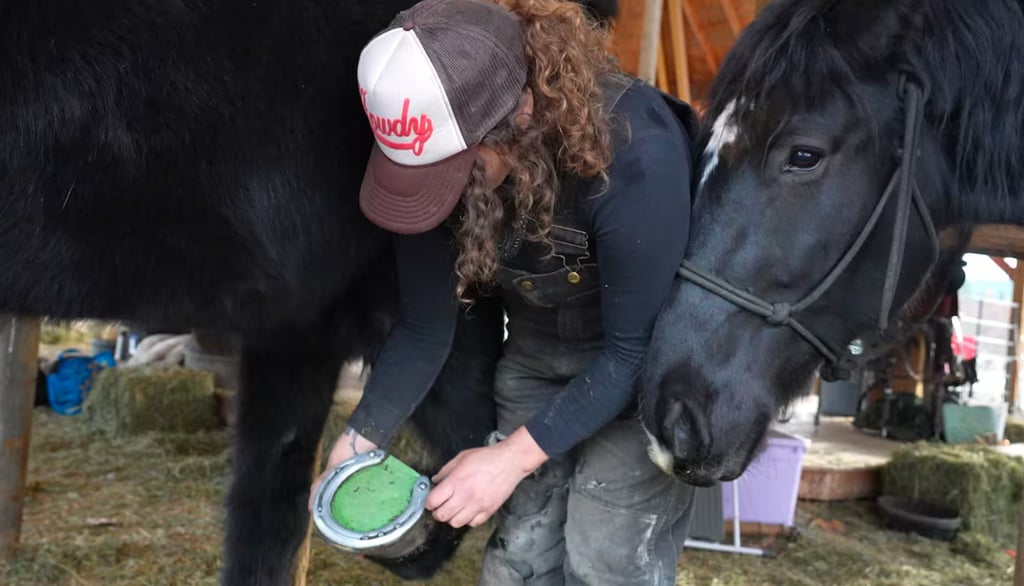
Caitlin MacDonald is one of several women helping horses navigate icy conditions by crafting specialized winter shoes designed for traction and snow control. During the colder months, she lives and works at the Caravan Theatre, where she cares for draft horses that pull sleighs full of theatre-goers across snowy grounds several times each night.
“These horses don’t even break a sweat,” MacDonald said. “They’re built for this kind of work.”
Outside of the theatre, many of the same horses haul logs in remote mountain terrain, work on farms, or pull carriages in urban parks like Stanley Park. Some weigh more than 900 kilograms and require shoes tailored not just for winter, but for their individual size, job and health needs.
MacDonald forges each shoe by hand, often welding tungsten carbide into the steel to create durable, grippy cleats. In especially icy conditions, she adds tungsten-tipped nails for extra bite. To prevent snow from packing into hooves — which can cause slipping — she fits bright-coloured snow pads or even custom-cut plastic liners.
“Every horse is different,” she said. “Age, workload, hoof shape — it all matters.”
Some of the largest horses, including Percherons, require antique or handmade traction devices known as corks. Their size is so extreme that commercially produced winter traction aids are no longer available.
A changing trade
When MacDonald trained as a farrier, she was the only woman in her class. Today, that’s no longer the case.
In the North Okanagan, women now make up the majority of working farriers — a shift that reflects both changing attitudes and the physical and technical demands of the job.
Shoeing draft horses is especially punishing. “It’s three times the work,” MacDonald said. “More steel, more weight, more strain on the body. Not everyone wants to do it.”
Support within the profession has become key. Jenn Thiele, a Salmon Arm–based farrier with two decades of experience, says collaboration is one of the strongest parts of the local farrier community.
“If someone needs help, we step in,” Thiele said. “We share X-rays, talk through shoe designs, and show up in the field when needed.”
Last year, when Thiele had to step away from work temporarily, fellow farriers took over her clients until she was able to return — a level of mutual support she says wasn’t always common in the trade.
Proving competence
Despite progress, Thiele says women still face assumptions in a male-dominated industry.
“Men are often assumed to be competent right away,” she said. “Women have to prove it.”
To do that, Thiele earned the highest level of farrier certification available in Canada, achieving journeyman status. Since then, she’s noticed a shift.
“People trust me more. They ask fewer questions because they know I’ve put in the work.”
While competitive farrier events often favour raw strength, Thiele says day-to-day work tells a different story.
“In the real world, problem-solving, precision and consistency matter more,” she said. “Women absolutely hold their own.”
As winter continues across the Okanagan, the horses keep working — and behind the scenes, a growing network of skilled women ensures they stay balanced, safe and ready for whatever the season brings.
News
Stay updated with the latest BC news stories, subscribe to our newsletter today.
SUBSCRIBE
© 2026 Innovatory Labs Inc. All rights reserved.
LINKS