
Inside a B.C. ‘dementia village’ that could transform long-term care
Liam O'Connell
12/26/20253 min read
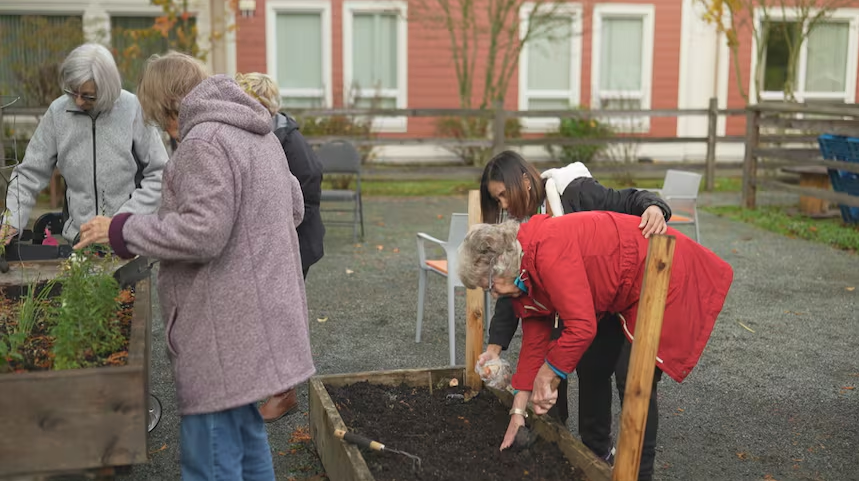
At 94, Doreen Freeland still finds joy in the soil.
Once a “land girl” in wartime Britain, Freeland spent her youth working farms and orchards during the Second World War. Decades later, living with dementia, she’s rediscovered that connection to the outdoors at The Village Langley — a care facility in the Fraser Valley designed to look and function like a small community rather than a hospital.
Instead of long corridors and locked wards, the five-acre site features cottages, gardens, a café, a hair salon, a woodworking shop and even a barn with animals. Residents are free to walk the grounds, garden, feed chickens or visit with friends.
“The goats are quite something,” Freeland says with a smile. “Sometimes I prefer animals to people.”
Freeland was diagnosed with dementia about five years ago and now lives with her daughter, Gail Deyle, who brings her to The Village’s adult day program every week.
“If we miss a Thursday, I hear about it,” Deyle jokes. “She lights up every time she comes here.”
After her diagnosis, Freeland moved from Nova Scotia to B.C., and Deyle left her job to become her full-time caregiver. Her mother is legally blind, but still eager to stay active.
“She once told me that if she can’t play in the dirt, she doesn’t want to be around,” Deyle says.
Opened in 2019, The Village Langley is home to about 75 full-time residents living in six cottage-style houses. Most are in the mid-to-late stages of dementia, though some have brain injuries, Parkinson’s disease or other cognitive challenges.
Co-founder Elroy Jespersen says the idea grew out of decades spent working in traditional seniors’ care.
“I kept seeing people with dementia struggling the most,” he says. “The solution was often to lock them down for safety. I thought — that’s not living.”
Inspired by dementia villages and “green care farms” in Europe, Jespersen set out to create a place that balances safety with autonomy.
“There’s dignity in risk,” he says. “No matter our limitations, we all want to live our best possible lives.”
The Langley site is one of the first dementia villages of its kind in Canada, with a similar project now operating in Comox, B.C.
Researchers are now studying whether the model delivers measurable benefits. A new project led by Simon Fraser University and McMaster University will examine how residents interact with outdoor spaces, animals and each other — and whether those elements improve sleep, mobility, mood and overall well-being.
Habib Chaudhury, a professor involved in the research, says international studies suggest farm-style care can reduce depression, improve sleep and lower fall risk.
“In Canada, long-term care is still largely institutional,” he says. “Often, quality of life is sacrificed in the name of safety.”
Beginning in 2026, the research team will interview residents, families and staff, gathering data that could help shape future long-term care policy.
Cost, however, remains a major barrier. Full-time residency at The Village Langley can cost between $10,000 and $13,000 per month, and the facility currently receives no government funding.
Jespersen hopes research evidence will eventually convince governments to invest in similar models and make them accessible to more families.
Experts caution that dementia villages are not a cure.
“They won’t stop the disease from progressing,” says Dr. Howard Chertkow, a cognitive neurologist in Toronto. “But they bring together things we know help — physical activity, social engagement and time outdoors.”
Canada’s dementia challenge is growing fast. More than 770,000 Canadians currently live with dementia, and that number is expected to climb sharply in coming decades. Advocates say isolation remains one of the most damaging factors.
“Isolation is the enemy of the dementia journey,” says Dave Spedding, a dementia advocate. “People stop being invited out, and their world shrinks.”
For Deyle, The Village has helped keep her mother’s world open.
“They cater to everything I like,” Freeland says, looking around the gardens.
And she knows it helps her daughter too.
“Gail is quite happy to leave me here and have a breather now and again,” she adds, laughing.
News
Stay updated with the latest BC news stories, subscribe to our newsletter today.
SUBSCRIBE
© 2026 Innovatory Labs Inc. All rights reserved.
LINKS