
Grace in the Wake of Horror: Tumbler Ridge Stands United After Devastating School Shooting
Subhadarshi Tripathy
2/16/20264 min read
On a cold Friday evening in Tumbler Ridge, hundreds of residents stood shoulder to shoulder, hands clasped tightly together.
“We all need to join hands,” Elder George Desjarlais of West Moberly First Nations told the crowd before beginning his prayer.
They did.
Parents wept quietly. Students leaned into teachers. Neighbours gripped each other as though bracing against another invisible wave. On stage, Prime Minister Mark Carney, Conservative Leader Pierre Poilievre, and Governor General Mary Simon stood side by side, hands joined in a rare display of unity.
They had come to honour eight lives lost in one of Canada’s most horrific school shootings.
A Town Built on Hope
Tumbler Ridge, population roughly 2,400, sits in the northern foothills of the Canadian Rockies near the Alberta border. Built in 1981 as an “instant town” for coal workers and their families, it reinvented itself after the mines shuttered in the 2000s. Residents promoted its quiet streets, dramatic mountain backdrops, and paleontological discoveries—including ancient ankylosaur footprints found south of town—as reasons to visit or retire there.
It was known as a place where you could drive from one end of town to the other in four minutes.
On February 10, that peace was shattered.
The First 24 Hours
Just before 2:30 p.m. Mountain Time, RCMP received reports of an active shooter at Tumbler Ridge Secondary School. Residents were told to shelter in place, lock doors, and avoid leaving homes or workplaces.
Police arrived within minutes.
Inside the school, six people were killed: five students aged 12 and 13, and a 39-year-old education assistant.
The 18-year-old gunman, Jesse Van Rootselaar, died from a self-inflicted gunshot wound, police said.
Later, officers discovered two more victims at the shooter’s family home: his mother, 39-year-old Jennifer Strang, and his 11-year-old half-brother, Emmett Jacobs. Investigators believe the shooter killed them before heading to the school.
The scale of loss stunned the tight-knit community.
Inside the Lockdown
Jarbas Noronha was teaching mechanics class when a student returned from the hallway saying he had heard gunshots.
At first, 17-year-old student Darian Quist wasn’t alarmed. Then the alarm system sounded. Text messages and graphic photos began circulating among students hiding in other parts of the building.
“We used tables to barricade the doors,” Noronha said. “Just to buy time.”
Students quietly discussed escape plans. Nervous jokes masked fear.
“My whole focus was getting these 15 students out of here safe,” Noronha said. “They were incredible under the circumstances.”
After roughly two hours, police escorted the class out with hands raised, past flashing lights and heavily armed officers, to the nearby community centre where parents waited in tears.
Dennis Campbell, president of the local minor hockey association, recalled his daughter’s call.
“‘Dad, there’s a shooting. There’s a shooting here.’”
She hid in a gym equipment room.
“My mind was going crazy,” he said.
In a town where most residents know one another, nearly everyone is connected to someone directly affected.
The Children and the Educator
The victims are being remembered not as statistics, but as vibrant young lives filled with promise.
The community mourns 12-year-olds Abel Mwansa, Zoey Benoit, Ticaria Lampert, and Kylie Smith, along with 13-year-old Ezekiel Schofield.
They were artists, athletes, dreamers—children who loved hockey, science, soccer, and figure skating.
The sixth school victim, 39-year-old Shannda Aviugana-Durand, was an education assistant remembered for her devotion to students.
Two other students—12-year-old Maya Gebala and 19-year-old Paige Hoekstra—were seriously injured and remain in recovery.
The grief extends beyond the school. Jennifer Strang and Emmett Jacobs are also mourned as part of this tragedy.
A Community Comes Together
In the days following the shooting, small acts of kindness began to fill the town.
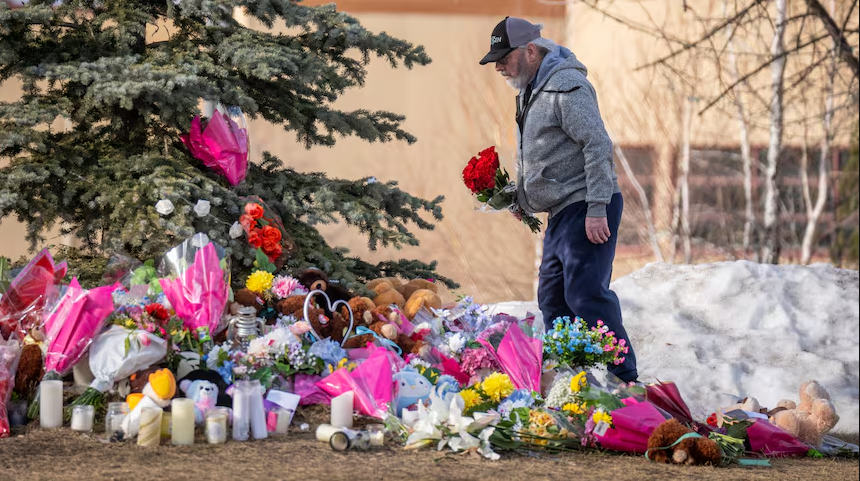
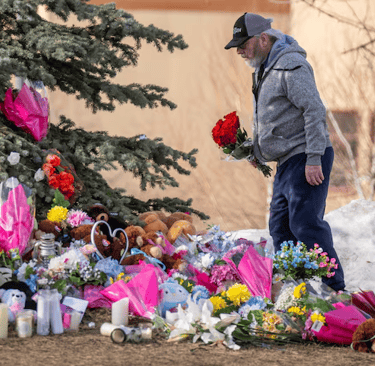
The local grocery store set up free coffee and cookies. Flower bouquets lined storefronts. Flags were lowered to half-mast. A memorial grew near the school’s entrance.
The town library stayed open as a sanctuary.
“We needed to provide some sense of normalcy and comfort,” said head librarian Paula Coutts. Regular programming was cancelled, but clay was provided for children to create with, and the Olympics played softly on a projector.
Residents gathered to talk, to cry, and simply to sit together.
Long-Term Healing
Mass shootings are rare in Canada, but their impact can ripple for years. In 2020, the Nova Scotia community of Portapique lost 13 residents in a mass shooting that killed 22 people in total. Leaders there say mental health supports must remain long after media attention fades.
Mayor Christine Blair of Colchester County has urged sustained trauma counselling, warning that anniversaries and delayed grief can reignite pain.
Tumbler Ridge’s mayor, Darryl Krakowka, has long advocated for stronger health-care resources in rural northern communities. The town faces shortages of doctors, nurses, and mental health professionals. Last fall, Northern Health Authority reduced on-call hours at the local health centre due to staffing gaps.
“As a community 120 kilometres from the nearest major facility, we shouldn’t have to hope tragedy happens only when the clinic is open,” Coutts said.
Premier David Eby has promised students they will not be forced to return to the same school building. Plans for trauma-informed education spaces are being developed.
Families are calling for lasting mental health services embedded in schools and communities.
“It should never get to this,” said Shanon Dycke, aunt of Kylie Smith.
Beyond the Tragedy
As national attention descends, local leaders are determined that Tumbler Ridge not be defined solely by this horror.
“This is a jewel of a community,” said Peace River South MLA Larry Neufeld. “The fabric has been torn. But it will heal.”
At the vigil, Prime Minister Carney spoke about grace—not as an abstract idea, but as something visible in neighbours holding hands.
“You held each other,” he said. “This is grace. Open hearts when the world falls apart.”
For Darian Quist, the 17-year-old who barricaded a classroom door, the path forward is rooted in that same closeness.
“Now more than ever,” he said, “we embrace the fact that we’re a small community. We hold each other close.”
In Tumbler Ridge, amid unimaginable loss, that may be the beginning of healing.
News
Stay updated with the latest BC news stories, subscribe to our newsletter today.
SUBSCRIBE
© 2026 Innovatory Labs Inc. All rights reserved.
LINKS