
Excitement builds — but questions linger — as aging B.C. Place readies for 2026 World Cup
Subhadarshi Tripathy
10/13/20253 min read
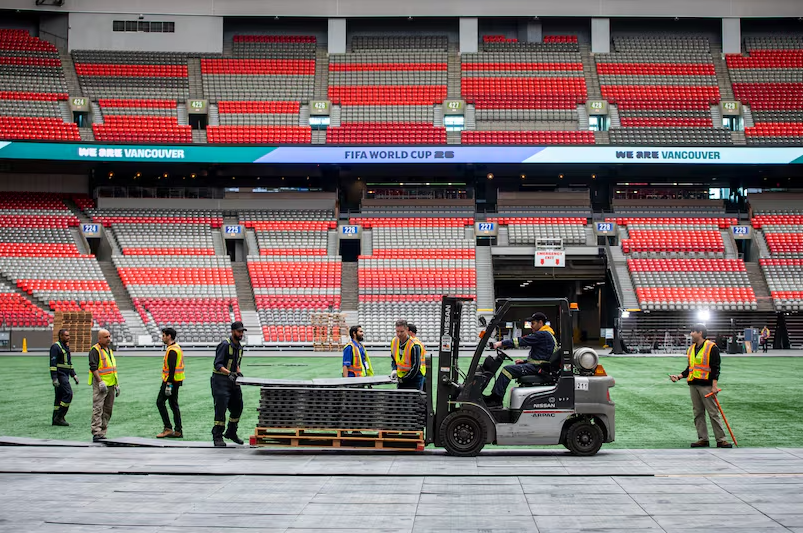
The countdown is on — and construction crews are hard at work inside and around B.C. Place Stadium, as Vancouver readies to welcome the world next summer.
The 2026 FIFA World Cup will mark Canada’s first time co-hosting the men’s tournament, with games split between Vancouver and Toronto. At B.C. Place, fans can expect upgrades ranging from new elevators and accessible entrances to expanded washrooms, gender-neutral facilities, and premium hospitality spaces.
“These aren’t just short-term improvements,” said Chris May, general manager of B.C. Place. “They’re designed to leave a lasting business and visitor legacy long after FIFA packs up.”
A costly legacy
But those legacies come with a hefty price tag.
The B.C. Pavilion Corporation — the Crown agency that runs the stadium — estimates upgrades and operations tied directly to the World Cup will cost $171–181 million. In total, city and provincial officials expect the full hosting bill to land between $483 million and $581 million, with a net public cost of about $100–145 million after revenue.
The spending builds on an already expensive history: the stadium’s 2011 renovation for the 2015 Women’s World Cup final cost more than $500 million.
One particularly debated upgrade is the temporary natural grass field, mandated by FIFA. The grass will be grown in the Fraser Valley, installed for the tournament, and then removed — replaced again with turf for the Vancouver Whitecaps and B.C. Lions.
Economist Moshe Lander calls that “money wasted.”
“Tell me why B.C. Place needs another round of upgrades if not for the World Cup,” Lander said. “This is a stadium built in another era, and we keep throwing money at it just to keep up.”
An old stadium in a tight space
Built in 1983, B.C. Place now sits at the heart of a densely developed downtown — surrounded by condos, restaurants, and Rogers Arena. Unlike other World Cup venues flanked by massive parking lots, B.C. Place is wedged into city blocks where space is scarce and traffic is constant.
“The area’s already a nightmare at rush hour,” said Lander. “When tens of thousands of fans flood in, it’s going to be intense.”
FIFA plans temporary road closures around the stadium and False Creek for security. Still, the location offers an upside: proximity to SkyTrain, bus routes, and bike paths. Most spectators, officials expect, will arrive without cars.
Neighbourhood bracing for crowds
For nearby businesses, the anticipation is mixed.
On Beatty Street, Mehdi Oraei, owner of Pane e Formaggio bakery, says he’s thrilled for the crowds — but nervous about deliveries.
“My main concern is how to get product in,” he said. “If Pacific Boulevard closes, it’s going to be tough. But if it stays open, we could have our best week ever.”
When Taylor Swift performed three sold-out shows last December, Oraei’s bakery pulled in nearly 20 days’ worth of sales in just three nights. “It was incredible,” he said. “We’re hoping for the same magic again.”
Across the street, Reliance Properties president Jon Stovell is racing to finish a renovation of a century-old warehouse at 837 Beatty Street — set to reopen as a modern office building by February.
“Yes, it’s inconvenient,” said Stovell, “but having the world’s attention on Vancouver for a few weeks far outweighs the temporary disruptions.”
What’s at stake
Canada is slated to play two group-stage matches at B.C. Place, with FIFA projecting the tournament could generate $3.8 billion in economic output across the country.
For Vancouver, the hope is that the upgrades — and the spotlight — leave a positive mark.
Still, as construction cranes loom over False Creek and costs climb past half a billion dollars, some residents can’t help but ask the same question that’s shadowed B.C. Place for decades:
Will this investment finally pay off — or just keep the stadium’s expensive cycle alive?
News
Stay updated with the latest BC news stories, subscribe to our newsletter today.
SUBSCRIBE
© 2026 Innovatory Labs Inc. All rights reserved.
LINKS