
Could reviving a long-lost lake help protect the Fraser Valley from future floods?
Olivia Singh
12/24/20253 min read
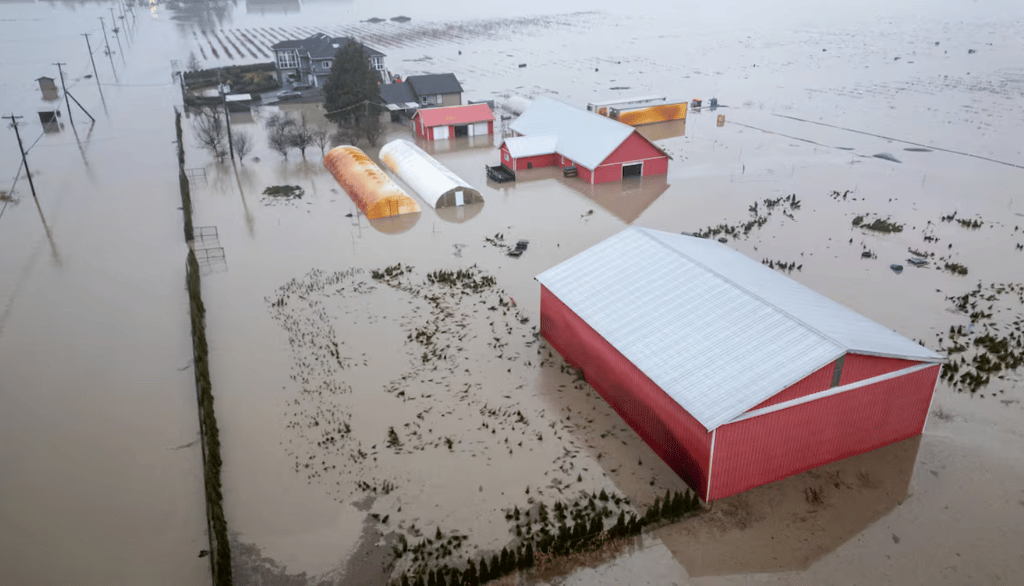
In the wake of renewed flooding in Abbotsford and on the territory of the Semá:th (Sumas) First Nation, some researchers and Indigenous leaders are again asking a controversial question: could restoring a long-drained lake be part of the solution to future floods?
Before the 1920s, much of what is now the Sumas Prairie was submerged under Sumas Lake — a vast floodplain whose size fluctuated between roughly 3,600 and more than 10,000 hectares. The lake was drained to create farmland, permanently reshaping the landscape and displacing the Semá:th people from a key source of food, transportation and cultural life.
“This is the Sumas River — pretty much what’s left of the remnant of Sumas Lake,” said Kwilosintun (Murray Ned), a member of the Semá:th First Nation and executive director of the Lower Fraser Fisheries Alliance, as he walked along the river following heavy rain.
The Fraser Valley has been hit repeatedly by floods in recent years, most notably in 2021, when floodwaters submerged farms, homes and highways, causing more than $450 million in insured damage across British Columbia. Similar flooding returned again this winter, reinforcing concerns that existing flood infrastructure may not be sufficient in a changing climate.
For Kwilosintun, the floods have been both destructive and revealing.
“It was tragic in terms of the chaos the water caused for people,” he said. “But it also showed us what this land used to be — and what it still wants to be.”
A landscape transformed
Sumas Lake once acted as a natural basin, absorbing excess water during heavy rainfall. Its drainage enabled agricultural expansion but removed a critical buffer against flooding. The project also severed the Semá:th Nation from a central part of its territory and livelihood.
“It meant everything to us,” Kwilosintun said. “When it was drained, we lost the resources that sustained our community.”
As climate change increases the intensity and frequency of storms, Kwilosintun believes rethinking the valley’s history could help shape its future.
“Instead of constantly trying to overpower nature with higher dikes and bigger pumps, we need to learn how to work with it,” he said.
Rethinking flood adaptation
Kwilosintun co-authored a 2024 study with University of British Columbia professor Tara Martin, which examined the feasibility of restoring Sumas Lake as a flood-mitigation strategy.
The study estimated that restoring the lake would require a planned relocation of residents and farmland, at a cost of roughly $1 billion for property buyouts. While significant, Martin argues it could be less expensive in the long term than traditional infrastructure.
“The current proposals for new dikes, pumping stations and upgrades exceed $2.4 billion,” said Martin, who leads UBC’s Conservation Decisions Lab. “And even then, those solutions aren’t guaranteed to work under future climate conditions.”
Despite the findings, Martin said the idea has gained little traction with local governments.
“There’s still a strong belief in business-as-usual engineering solutions,” she said. “The challenge is that those approaches may not be resilient enough as conditions continue to change.”
Political and economic hurdles
The City of Abbotsford has stated it prioritizes flood protection infrastructure over restoring the lake, noting that re-flooding the prairie would require coordination across municipal, provincial and federal governments.
In 2023, the city submitted a $1.6 billion funding request to the federal Disaster Mitigation and Adaptation Fund for long-term flood protection projects, including a new pumping station. The request was rejected in 2024 due to limited federal funding capacity.
Kwilosintun says the federal government needs to play a more active role.
“We need federal decision-makers at the table — not just funding announcements,” he said.
Researchers also acknowledge that more detailed economic analysis is needed, particularly around the impact on agriculture, which remains a cornerstone of the Fraser Valley economy.
“We don’t want to see people displaced,” Kwilosintun said. “But we do want balance — with the ecosystem, with the spirit of the lake, and with the land itself.”
For him, the question isn’t whether the lake will return, but how.
“I think it’s always been a lake,” he said. “And within this century, one way or another, I believe it will return.”
News
Stay updated with the latest BC news stories, subscribe to our newsletter today.
SUBSCRIBE
© 2026 Innovatory Labs Inc. All rights reserved.
LINKS