
B.C. First Nation builds innovative prefabricated homes using wood from its own territory
Shraddha Tripathy
1/2/20262 min read

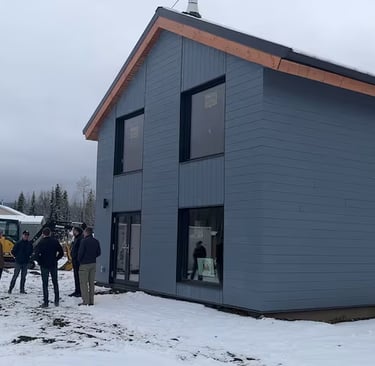
A new kind of home now stands in Nak’azdli Whuten, offering a glimpse of what housing in northern B.C. could look like in the future.
The two-storey structure is the first prototype of an Indigenous-led prefabricated housing system that turns locally harvested, low-grade wood into mass-timber panels. Those panels are manufactured nearby, then assembled on site in a matter of days.
“This house represents security — not just in housing, but in economic opportunity and community longevity,” said Nak’azdli Whuten member Elky Taylor. “We’ve had limited economic options in Fort St. James for a long time. Creating a secondary industry from our own timber has been a long-held goal.”
The pilot project is a collaboration between Nak’azdli Whuten Development Corp. and Deadwood Innovations, a Fort St. James–based forestry startup, with technical support from researchers at the University of Northern British Columbia.
Housing built for the North
Mass timber refers to engineered wood products made by bonding layers of lumber into strong structural elements such as panels, beams and columns. While mass timber is commonly used in large urban buildings, this project adapts the technology for housing in rural and Indigenous communities.
Deadwood Innovations CEO Owen Miller said the goal is to rethink how northern housing is built.
“This approach taps into local resources, local skills and local labour,” he said. “It’s about creating housing that reflects community needs, is environmentally responsible and can be built at a cost northern families can afford.”
Because the panels are fabricated indoors, quality control is higher than traditional on-site construction, said Jianhui Zhou, an associate professor of wood engineering at UNBC.
“Prefabrication allows us to build faster, with greater precision, and with consistent quality,” Zhou said. “It also allows communities to use their own materials to address housing shortages.”
From raw logs to finished homes
The mass-timber panels used in the show home were produced at a former finger-joint plant in Fort St. James, now repurposed by Deadwood Innovations to upgrade lumber harvested from the surrounding territory.
Architect Neil Prakash said the idea grew from a familiar frustration.
“We kept watching logging trucks leave the community loaded with raw logs,” he said. “We started asking why that value couldn’t stay here — why those logs couldn’t come back as finished building components instead.”
The finished home includes three bedrooms, two bathrooms, a loft and an open-concept kitchen and living area. Exposed mass-timber walls, floors and ceilings showcase the material while reducing the need for additional finishes.
Structural engineer Mike Gehloff said the system is highly adaptable.
“This isn’t just one design,” he said. “The same panel system can be used for cabins, single-storey homes or larger multi-bedroom houses. The real power is that it can be done locally, by smaller producers, for local markets.”
Looking ahead
Nak’azdli Whuten Development Corp. CEO John-Paul Wenger said the long-term vision is to scale up production.
“Panels can be built during the winter, and homes can go up quickly in the summer,” he said. “Instead of producing just a couple of houses, we could be building 10 or more each season using local crews and contractors.”
The prototype will serve as a demonstration home for about 18 months. After that, it will be gifted to a Nak’azdli family or elder.
For Taylor, the project is about more than housing.
“It creates pride,” she said. “It shows what we’re capable of — that we can build homes, create jobs and shape our own future using the resources from our land.”
News
Stay updated with the latest BC news stories, subscribe to our newsletter today.
SUBSCRIBE
© 2026 Innovatory Labs Inc. All rights reserved.
LINKS